hello@yurtinthedirt.com.au
 +61 489 269 088


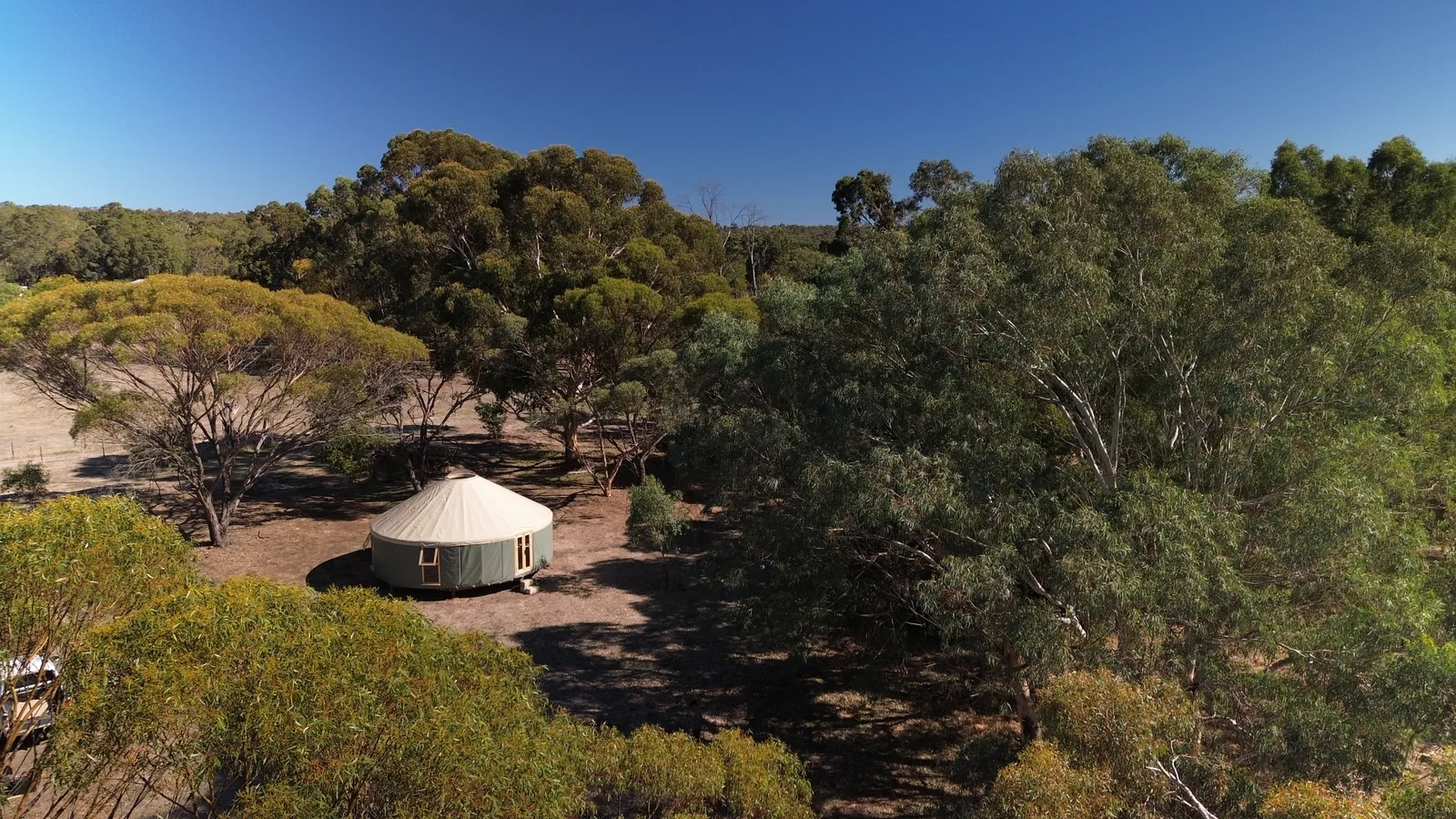
A yurt is a round, timber-framed dwelling. It has a folding lattice wall, roof poles that run up to a ring called the crown, and an insulated fabric cover over the lot. Yurts started out as the portable homes of nomadic herders in Mongolia and Central Asia. In New Zealand today, people put them up as sleepouts, studios, glamping stays and off-grid homes on lifestyle blocks.
Yurts in NZ: the short version
- Shape: round, with no posts in the middle, so every bit of floor is usable.
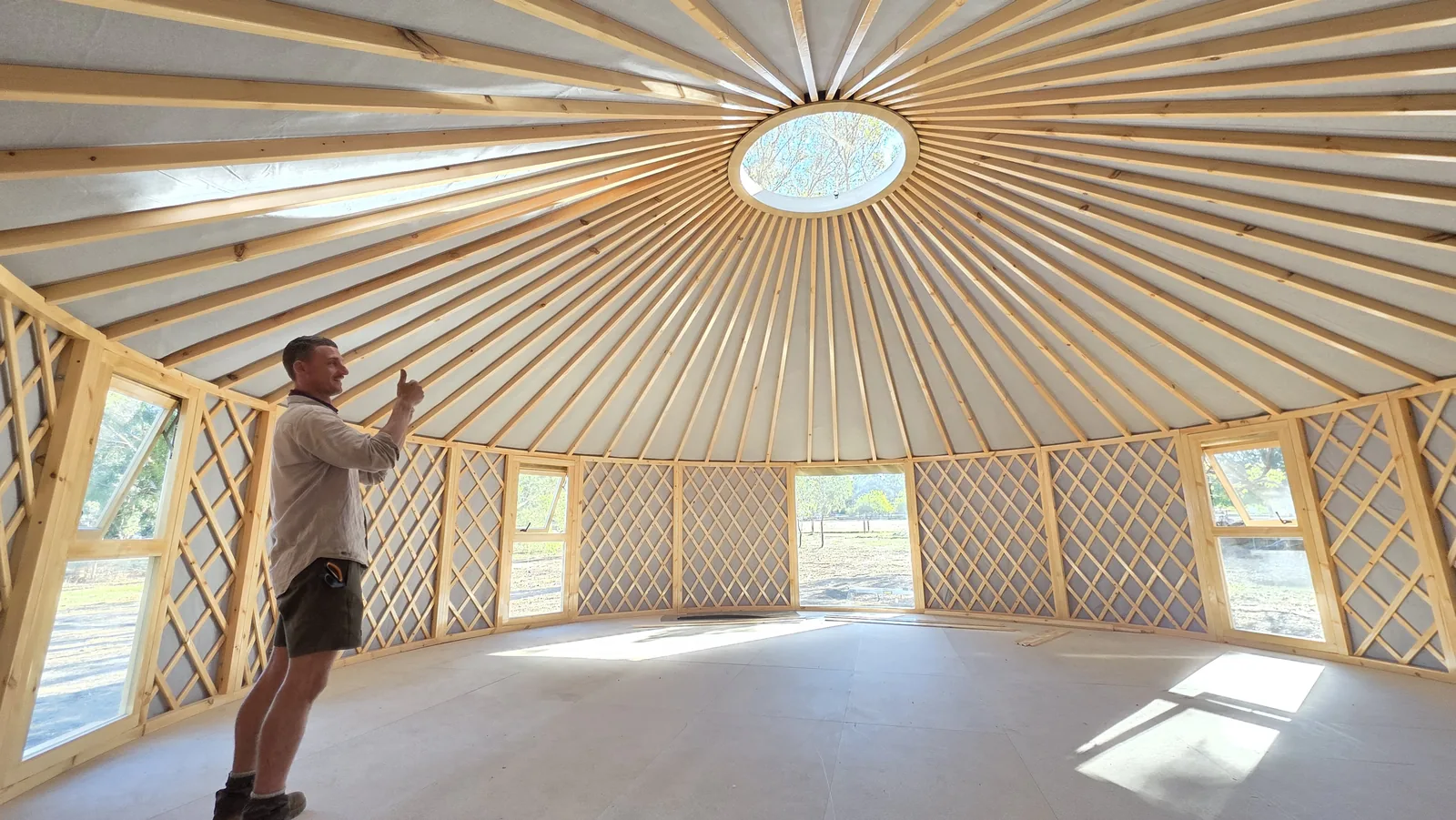
- Frame: timber lattice wall, timber roof poles and a crown with a clear dome skylight.
- Cover: a waterproof outer cover with insulation and a liner underneath.
- Base: a timber deck the same diameter as the yurt.
- Our sizes in NZ: ORON yurts from 5m (20 sqm) to 10m (80 sqm), plus a 12m on request.
- Price: ORON kits from $17,890 NZD ex GST, as at October 2026.
- Getting it here: shipped to your nearest major port, such as Auckland, Wellington or Christchurch.
Where does the yurt come from?
The yurt comes from the steppes of Central Asia, where herding families have lived in them for thousands of years. They needed a home they could pack onto animals, carry to fresh grazing and put back up. The yurt did exactly that.
In Mongolia it's called a ger, which simply means home. "Yurt" comes from a Turkic word for a dwelling place or homeland, and English picked it up through Russian. So when a Kiwi says yurt and a Mongolian says ger, they're talking about the same thing.
The traditional ger has three main parts, and each has a name:
- Khana: the lattice wall, made from willow or birch strips that fold up like a child's safety gate.
- Uni: the roof poles.
- Toono: the crown at the top, which lets smoke out and light in.
The crown matters so much that it's on Kyrgyzstan's national flag. Plenty of Mongolian families still live in gers today, out on the steppe and on the edges of Ulaanbaatar.
How is a modern yurt different from a Mongolian ger?
The bones are the same. A circle of lattice, poles to a crown, a tension band holding it all in. What's changed is the materials, and what people expect from the inside.
| Traditional Mongolian ger | Modern yurt (our ORON) | |
|---|---|---|
| Wall | Willow or birch lattice | Heat-treated timber lattice |
| Insulation | Layers of sheep's wool felt | Natural wool felt, with a double layer option |
| Cover | Canvas over felt | Waterproof outer cover with a tough matte finish |
| Door | Small painted timber door | Hardwood doors and full-height windows |
| Crown | Open timber ring for the stove flue | Timber compression ring with an acrylic dome skylight |
| Floor | Rugs on the ground | Timber deck, built to the yurt's diameter |
| Built to | Move with the seasons | Stay put for years |
A ger is meant to come down a few times a year. Most yurts in NZ go up once and stay up, so the frame can be heavier, the windows can be glass, and the floor can be a proper deck.
How is a yurt built?
A yurt goes up in a fixed order: the deck, the lattice wall, the roof poles, the crown, then the cover. Once the deck is ready, most of our clients have the yurt standing in 2 to 3 days with a few friends or family helping.
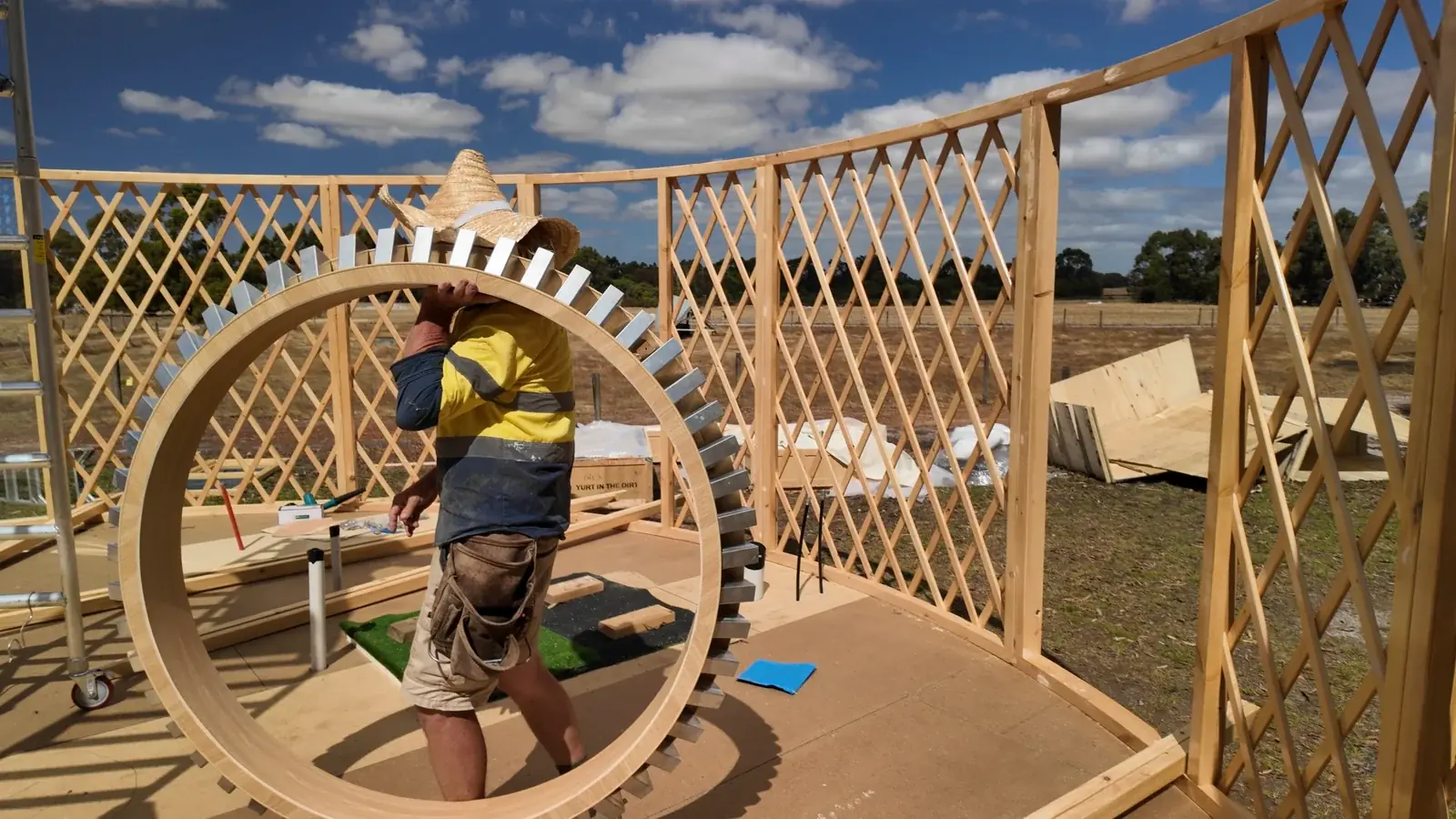
- Deck. A level timber platform the same diameter as the yurt, never bigger. The outer cover hangs over the edge to shed water, so a bigger deck lets rain run in underneath.
- Lattice wall. It opens out into a circle, with the door frame set into it.
- Roof poles. These run from the top of the wall up to the crown.
- Crown. The ring at the top that holds the poles and carries the skylight.
- Cover. Insulation and liner first, then the waterproof outer cover, pulled down and tensioned.
If your yurt will sit next to a larger deck, keep the yurt circle raised above it, or leave a 10 to 20mm gap between the two. Our yurt platform guide has the detail, and what is a yurt made of goes through each layer.
Is a yurt a tent or a house?
Somewhere in between. The walls and roof are fabric, so a yurt is lighter and quicker to build than a timber cabin. But it has a rigid frame, real doors, glass windows, insulation and a timber floor. Inside, it feels like a room, not a tent.
How it lives depends on the fit-out. Put a bed and a rug in and you've got a lovely sleepout. Add a kitchenette, a wood burner and a bathroom close by, and it starts to feel like a small home.
We know because we did it. Our family and I lived off-grid for four years in an 8m yurt on a friend's farm before we started Yurt in the Dirt. Through hot summers and cold, wet winters. Those years taught us what a yurt needs to be comfortable, and that's what went into ORON.
What do people in NZ use yurts for?
Most Kiwi buyers want extra space that's quicker and simpler than building. The common ones we hear about:
- Sleepout. Room for teenagers, guests or grandparents without extending the house.
- Studio or home office. A quiet round room down the garden.
- At the holiday house. Extra beds for the summer crowd.
- Glamping. A yurt photographs well for a guest listing.
- On a lifestyle block. A place to live while you work out the bigger plan.
Whatever you have in mind, check with your local council about how you plan to use it before you order.
Will a yurt cope with New Zealand weather?
Yes, when it's set up for your site. The round shape has no flat wall for the wind to push against, so it spreads the load all the way round. They've handled winds of around 120 km/h, though that's not an official rating.
NZ weather varies a lot from one end to the other, so plan for yours:
- Wind. On exposed coastal sections, around Wellington or in the path of a Canterbury nor'wester, tie the deck down well, keep the cover tensioned and face the door away from the prevailing wind.
- Rain. In Northland, the West Coast or anywhere wet, the same-diameter deck is what keeps water out. The cover hangs past the edge and drips clear of the floor.
- Frost and snow. For Central Otago, the high country or Southland winters, add the double wool felt and plan for a wood burner or heat pump. Wondering how a yurt copes with a proper cold snap? Ask us about the builds our clients have done across New Zealand and in cold country like Tasmania.
What does a yurt cost in NZ?
Our ORON yurt kits run from $17,890 for a 5m to $39,890 for a 10m, in NZD ex GST as at October 2026. Shipping to your nearest major New Zealand port is included, and GST is added on your NZD invoice.
ORON yurt prices (NZD ex GST, as at October 2026)
| Size | Floor area | Kit price |
|---|---|---|
| 5m | 20 sqm | $17,890 |
| 6m | 30 sqm | $20,490 |
| 7m | 40 sqm | $23,590 |
| 8m | 50 sqm | $26,090 |
| 9m | 63 sqm | $34,690 |
| 10m | 80 sqm | $39,890 |
| 12m | On request | Price on application |
ORON is our flagship. It has a 60% heavier timber frame, hardwood doors and windows, natural wool felt insulation and a tough matte exterior. It's stronger, more comfortable and better looking than a conventional yurt. Colours are Bushland, Sand Dune, Red Ochre, Riverstone and Deepwater.
If the view is the main event, our Geo Domes run from $17,990 for a 5m to $32,990 for a 10m, NZD ex GST as at October 2026. A double-glazed glass front is a paid option, priced on quotation.
The kit is the yurt itself. The deck, flooring, fit-out, plumbing, electrical and installation are extra. Final delivery from the port to your place is quoted separately, or you can collect from the port warehouse. Our NZ buyer's guide to yurts for sale covers add-ons and the full cost picture.
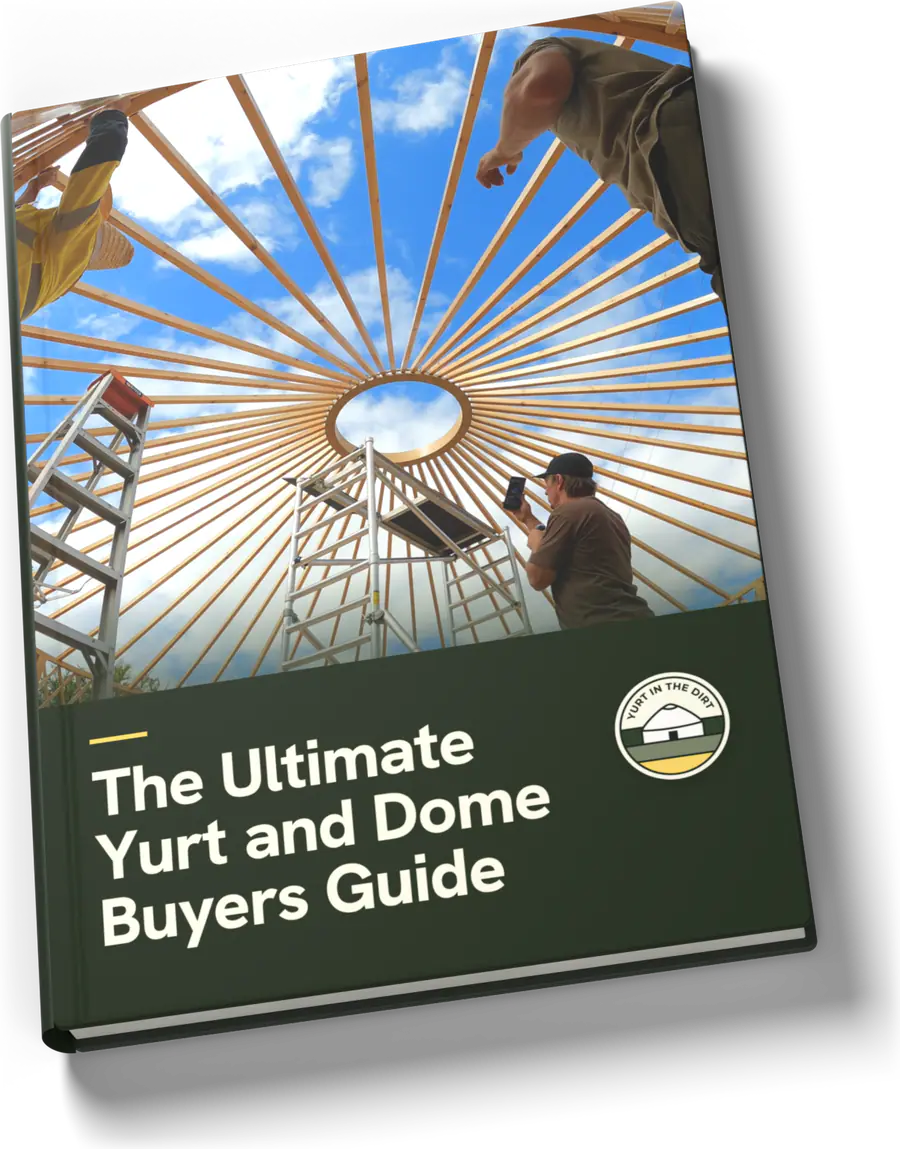
Get the free buyer's guide
Grab our free buyer's guide and unlock $2,100+ in savings, including $500 off any yurt or Geo Dome. It covers sizing, decks, upgrades and the build steps we've learned from over 150 client builds across Australia and New Zealand. Get the buyer's guide
Frequently asked questions
What is a yurt in simple terms?
A round, timber-framed dwelling with a lattice wall, roof poles meeting a central crown, and an insulated fabric cover. It sits on a timber deck and goes up in days, not months.
What is the difference between a yurt and a ger?
Nothing, really. Ger is the Mongolian word, and yurt is the Turkic word English borrowed through Russian. Modern yurts use heavier frames, glass windows and waterproof covers, but the design is the same.
How much does a yurt cost in NZ?
Our ORON yurt kits run from $17,890 to $39,890 NZD ex GST, as at October 2026, with shipping to your nearest major NZ port included. The deck, fit-out and services are extra.
Do yurts have bathrooms?
Not in the kit. Plumbing isn't included, so most people build a small bathroom close by or have a plumber fit one inside.
How long does a yurt last?
On our kits, the frame, doors and windows last longer with proper care. The outer cover usually lasts around 7 years and can be replaced without touching the frame.
Can a yurt handle New Zealand wind?
Yes, when it's tied down to a solid deck and the cover is kept tensioned. They've handled winds of around 120 km/h, though that's not an official rating. Exposed sites need extra care with anchoring.
Are yurts warm in a New Zealand winter?
With the right setup, yes. ORON yurts have wool felt insulation, and a double layer plus a wood burner or heat pump keeps them cosy in frosty places like Central Otago.